How Lumin works · the operating model

Agents propose. People approve. Software enforces the limits.

We are an agency, not a software vendor. But the reason a small team can run your web, search and ads together — and show you a record of every change — is that we wrote the software we run them with.

Lumin CMS
Lumin Ads
Scheduled agents
Human approvals
Hard caps
The model · What you're hiring

Four things that make this different.

  1. 01

    A small team, not a pod

    You get named people, not an account-manager layer in front of the people doing the work. The person who approves a change is someone you can email.

  2. 02

    Agents on schedules

    Each agent has one job — mine search terms, pace budget, audit tracking, flag stale pages — and a shift it runs on. They inspect and propose; they cannot apply.

  3. 03

    One approvals queue

    Web changes and ad changes land in the same place, with the evidence attached. That is why the two sides of your marketing stay in step.

  4. 04

    A record that outlives us

    Every applied change carries what, why, who approved it and when. If you leave, the accounts, the content and the history are yours.

Why we're different · The operating system

Most agencies rent their tools. We built ours.

Two platforms we wrote and run ourselves. They are how the work gets done faster and gets recorded properly — not a product you have to learn. Most clients never log in.

01 · Lumin CMS · The web and search layer

Publishes your site, and keeps working on it.

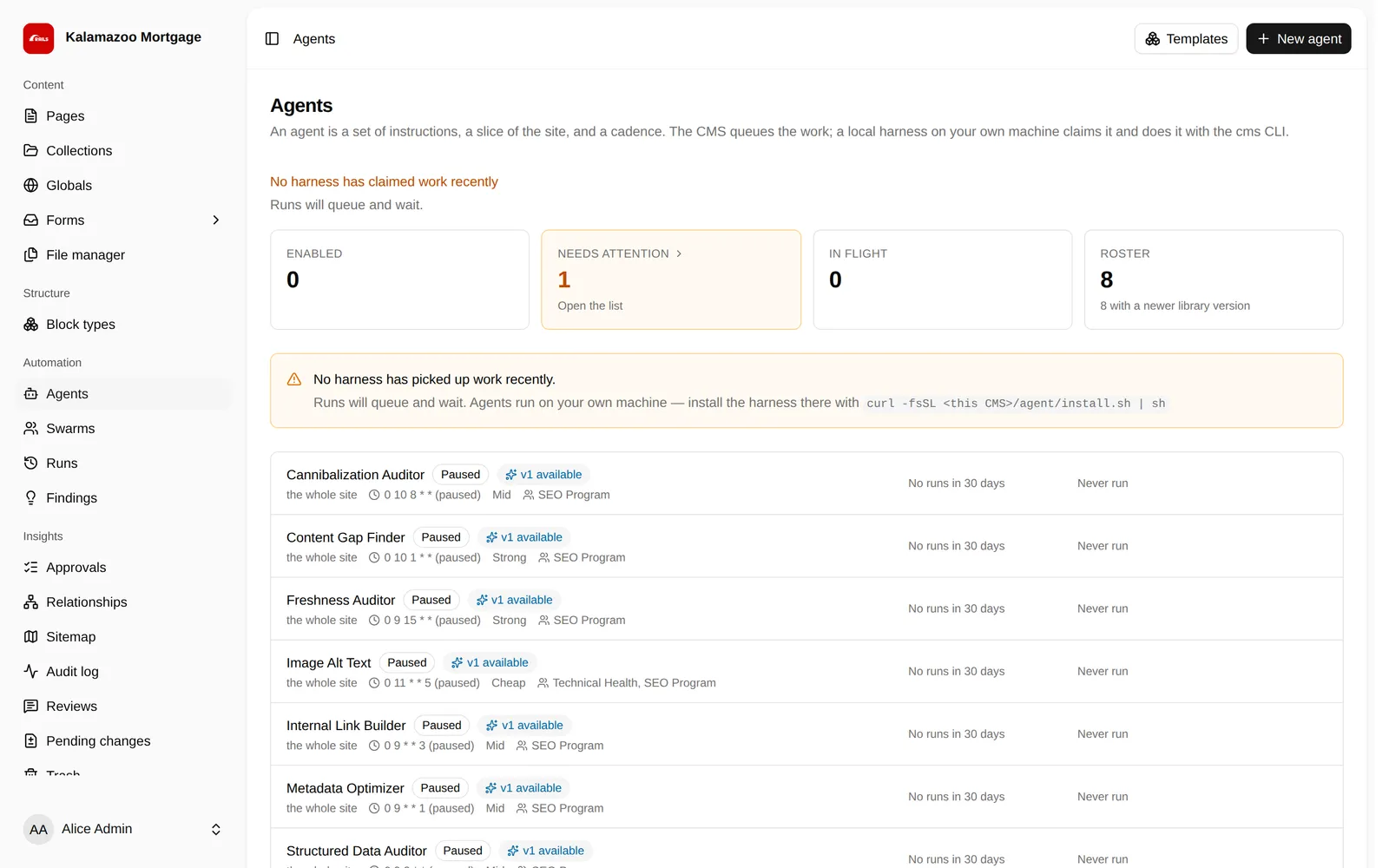
Pages, locations, forms and revisions live in one system of record. A crew of agents each own one job — freshness, internal links, structured data, location pages, metadata — and run it on a schedule. Every edit to a live page is a revision waiting for an editor.

  • Edits live in under a minute
  • Migrations preserve every URL
  • Location data held once, published everywhere
  • Agents draft, an editor approves
The website agents in Lumin CMS and the jobs each one runs
The website crew in Lumin CMS. One job each, on a schedule.

02 · Lumin Ads · The paid media layer

Governs the spend, and closes the feedback loop.

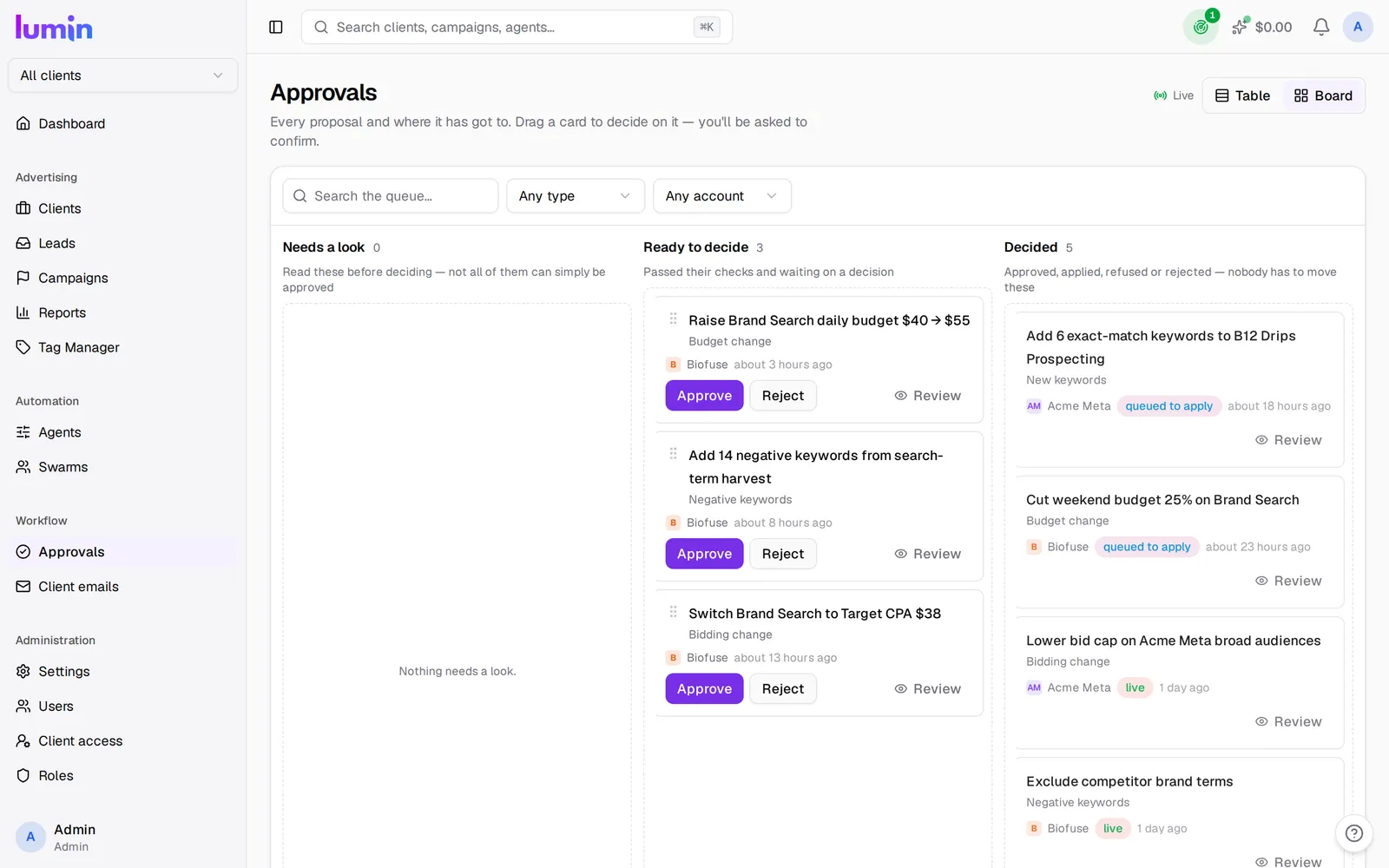
Google, Microsoft, Meta and ChatGPT in one place. Agents mine search terms, pace budget, audit conversion tracking and rewrite tired copy around the clock. Everything they propose lands in a single approvals queue, and sold-lead outcomes go back to the platforms.

  • One approvals queue for every channel
  • Spend caps enforced at the apply gate
  • Sold and lost fed back as offline conversions
  • Your accounts, your name, revocable access
The approvals board in Lumin Ads showing proposed changes waiting for a person
The approvals board in Lumin Ads. Nothing applies until a person signs.

You are not buying software. Lumin CMS and Lumin Ads are internal operating infrastructure. You buy web, search and advertising as a service; these are what let a small team run them at the pace of a much larger one, and leave a record of every change.

See how it works
The human gate · Who signs

Agents do the work. A person signs for it.

Nothing consequential reaches a live account or a live page on its own. Four roles, in order, every time.

  1. 01
    The agent proposes. Every change is written up first: what, why, and the evidence — including the money at stake. It has no ability to apply anything.
  2. 02
    A GoLumin operator approves. A named person signs or rejects. Never their own work. Their name stays on the record next to the change.
  3. 03
    The software enforces. Spend caps are hard limits at the apply gate. A change over the cap cannot apply, even after a human approves it.
  4. 04
    You can stop it. One switch pauses every agent on your account, instantly, without a support ticket or a phone call.

What never runs on its own

NPApprovals · Northwind Plumbing3 waiting
Add 14 negative keywords · Search, Emergency RepairsWasted Spend Cutter · est. $412/mo spent on non-converting termsApproveReject
Raise daily budget $60 → $75 · Water HeatersBudget Pacing Monitor · impression share lost to budget 31%within capApprove
Raise daily budget $75 → $240 · Water HeatersBlocked at the apply gate: exceeds the 40% per-change capblocked by hard cap
Remove the $300/day price row · Search, BrandFrom your email · approved by Ted at GoLumin · applied 14:02 · recordedapplied
AI spend this month: $38.20agents: 9 scheduled · next run 06:00

The approvals queue in Lumin Ads, running on a demo account.

Worked example · One email

Email at 9:14. Approved at 9:31.

What the gate looks like from your side: no ticket queue, no Tuesday meeting. An agent reads the live account, a person decides.

  1. You
    9:14

    “We're still getting calls about the $300/day ad. Can we fix it?”

  2. Agent
    9:15

    Reads the live account. Finds the price extension. Drafts the removal.

  3. Person
    9:31

    Checks it, approves it. Applied. You get a reply, not a ticket.

An illustration of the approval path, not a response-time guarantee. Turnaround depends on the change and who has to sign it.

What you see · Your app

Leads on your phone in seconds.

Your own app, in your brand. Push notification, tap to call, speed-to-lead measured. One plain-English email every Friday. No dashboards.

9:41●●● 5G
NPNorthwind Plumbing Leads
Today 3Cost/lead $31Reply 4m
  • Marcus T.new
    Water heater replacement, today
    Google lead form · 2m agoCallText
  • (269) 555-0142called
    Inbound call, 4 min 12 s
    Phone · 26m ago
  • Priya R.contacted
    Quote for drain cleaning, Portage
    Website · 1h ago
  • Dale W.sold
    Sump pump, basement flooding
    Meta lead ad · Yesterday
Push: new lead from Google · 2m ago
Operating proof · verifiable, not asserted

The strongest proof isn't that we use AI. It's the record of what changed, who approved it, and what happened next.

<1 min

Approved edit to live page

A property of the CMS, not a service-level promise. The publish is the deploy.

0

Changes applied without a named approver

Agents have no apply permission. Every consequential change carries a person's name.

Hard

Spend caps, enforced in code

A proposal over the cap is blocked at the apply gate — even when a human has approved it.

Outcome numbers — leads, cost per qualified lead, revenue — belong to a client and a timeframe, so we publish them on the case study that can carry the baseline and the method, not in a headline.10 client sites live today →

Questions · First call

What people ask about the agents.

What exactly can an agent do without a human?

Read. Agents have read access to your accounts and content, and no apply permission. They can inspect, research, draft and propose. Applying anything consequential requires a named approver, and the spend caps are enforced separately at the apply gate.

Which model runs the agents?

The agents are driven through Claude and local harnesses. Which model runs a given job is an implementation detail we change when a better one ships; the approval gate and the caps do not change with it.

What happens if an agent proposes something bad?

It gets rejected, and the rejection is part of the record. A proposal that exceeds a hard cap never reaches an approver's judgement at all — it is blocked at the apply gate.

Can I see the queue?

Yes. Clients who want visibility get access to the approvals history for their own account. Most prefer the weekly email, so that is the default.

Do I have to learn your software?

No. Most clients never log in. The deliverable is the marketing, not the tool.

Marketing audit · Start here

Pick the audit you actually need.

Website, local and AI search, ad account, or all three. Read-only access, real findings on your own accounts, and a person who walks you through them. You keep the findings either way.

  • Read-only access — nothing changes
  • No obligation, no slide deck
  • This form is a lead in our own inbox, timer running on us
Or call us:(269) 532-6248
Request a marketing audit →