
 Certified Google PartnerBadged by Google, not drawn by us. 15+ years in paid search.
Google Ads, worked every day. Not checked on Mondays.
Search and Maps ads in your own account, read every morning by software we built and signed off by a Google Partner. Negatives proposed with the dollars attached, a landing page built for the search, and sold leads fed back so Google learns what a customer looks like instead of what a form fill looks like.
in client ad spend managed, most of it on Google
buying clicks in personal injury and mass tort law, where one click can cost hundreds of dollars
search terms, pacing, tracking and copy reviewed, weekends included
Five problems, one cause each.
Most Google Ads accounts don't need more budget. They need someone to read them. Each of these has a specific, findable cause, and each one is visible in an afternoon if someone actually looks.
“We're paying for searches that will never buy.”
Search terms are read every day and negatives proposed with the wasted spend attached, so you can see what each one cost before you approve it. Job seekers, DIY-ers, the wrong city: the list that stops it, written and ready.
“The clicks come in and nothing happens.”
Almost always the page. A homepage gives a visitor nine things to do; a landing page gives them one. We build the page the ad lands on, for the search it came from.
“Our cost per lead looks fine and the leads are junk.”
Mark a lead sold or lost. That verdict goes back to Google as an offline conversion, so bidding optimises toward customers instead of form fills.
“Budget runs out on the 20th.”
Pacing is watched against the month, and spend limits are hard limits in software rather than a note in someone's calendar.
“Nobody can tell us what changed or why.”
Every change carries its evidence, its approver and its timestamp, and the record stays in your account's history. Ask any agency for its change history. If nobody can produce it, that's the answer.
Read the market before you spend on it.
A new account starts small and structured to learn, not to impress. The point of the first weeks is clean signal: which searches in which towns actually produce customers, at what cost. Then the money follows the evidence.
One campaign per location, $30 to $50 a day
Each town or facility gets its own campaign and budget, so its impression share and conversion rate are readable on their own. Broad match on the non-brand terms, so the search-terms report fills with what people actually type.
Brand carved out, exact match
Every spelling of your name runs in its own cheap campaign, and a brand negative list sits on everything else. Your non-brand numbers stay honest instead of being flattered by people who were already looking for you.
Ads written in full, not placeholders
Fifteen headlines and four descriptions per ad group, with the searcher's keyword and city inserted, every character counted. Claims come from your site: real prices, real hours, real promotions, nothing invented.
Tracking proven before bidding is trusted
Conversion tracking is wrong in more accounts than it's right. We verify what every conversion action fires on, check what's published versus what's live in Tag Manager, and only then let Google's bidding learn from it.
Budget follows the evidence
The locations and themes that produce customers get more. The ones that don't get cut, with the dollars that justify it. Kalamazoo Mortgage went from $30 a day to $100 this way, and stopped there only because the sales team was full.
The landing page, built for the search
Written for one search, built to be read on a phone, one form and one number, tracked end to end. On its own it's a $2,500 build. It is included, on your domain, and it stays yours.
What gets checked while you're running the business.
Each check has one job and a schedule. The software reads your account, writes up what it found with the dollars at stake, and drafts the fix. It cannot apply anything. Jordan reads what it wrote and decides.
- Search-term harvest. Every new query, sorted into keywords worth adding and negatives worth adding, each with its spend.
- Budget pacing. Whether the month runs dry on the 20th, and whether money sits in campaigns converting worse than the ones starved of it.
- Waste cutter. Terms, placements and hours that spend and never convert, flagged the day it starts, not the month after.
- Ads optimiser. Click-through, conversion rate and cost per lead by ad and ad group; tired copy proposed for replacement.
- Tracking audit. Tags edited but never published, conversions counting page views, calls nobody is recording.
- Competitive research. Who outranks you for the searches you already win, and what they're saying.
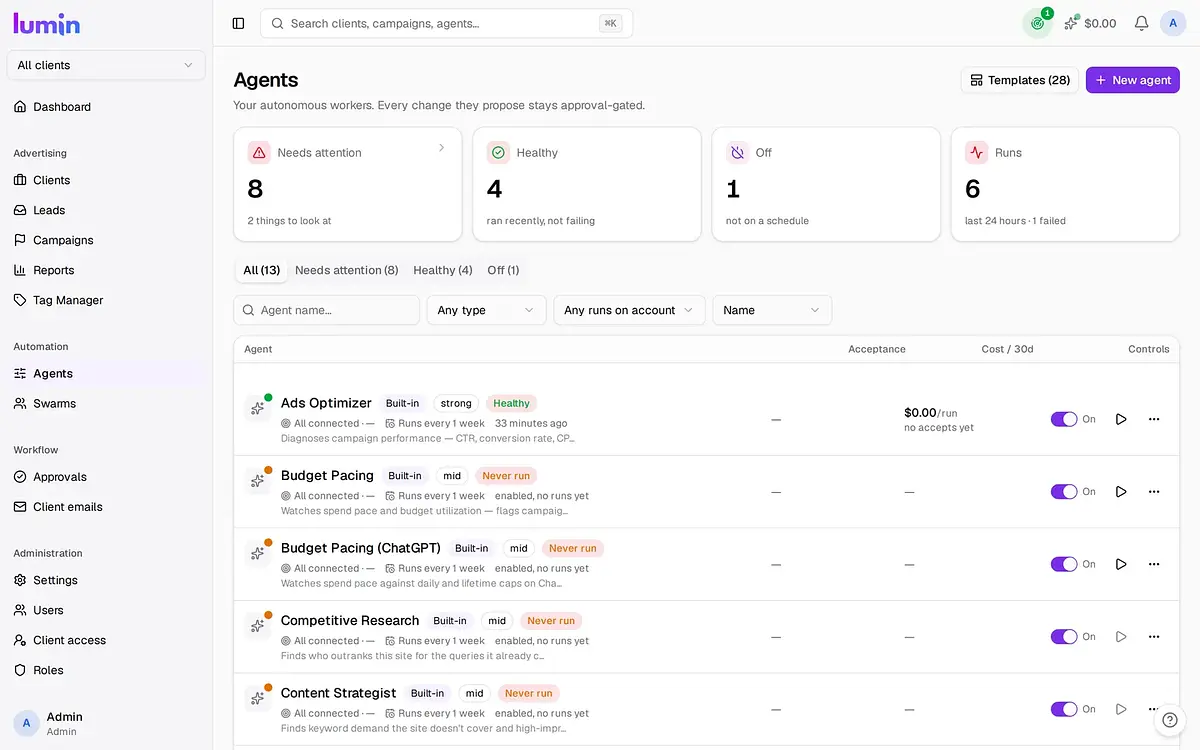
Every change is a draft until a person signs.
A proposed change lands in one queue with its evidence and the money at stake. Jordan or Ted approves it or rejects it; neither can approve their own proposal. Spend limits are enforced in code and can't be overridden, even by an approver. You can pause everything with one switch.
Email us at 9:14 about the ad quoting the wrong price, and the fix is drafted from the live account by 9:15 and applied by a person by 9:31. An illustration of the path, not a promise of the minutes.
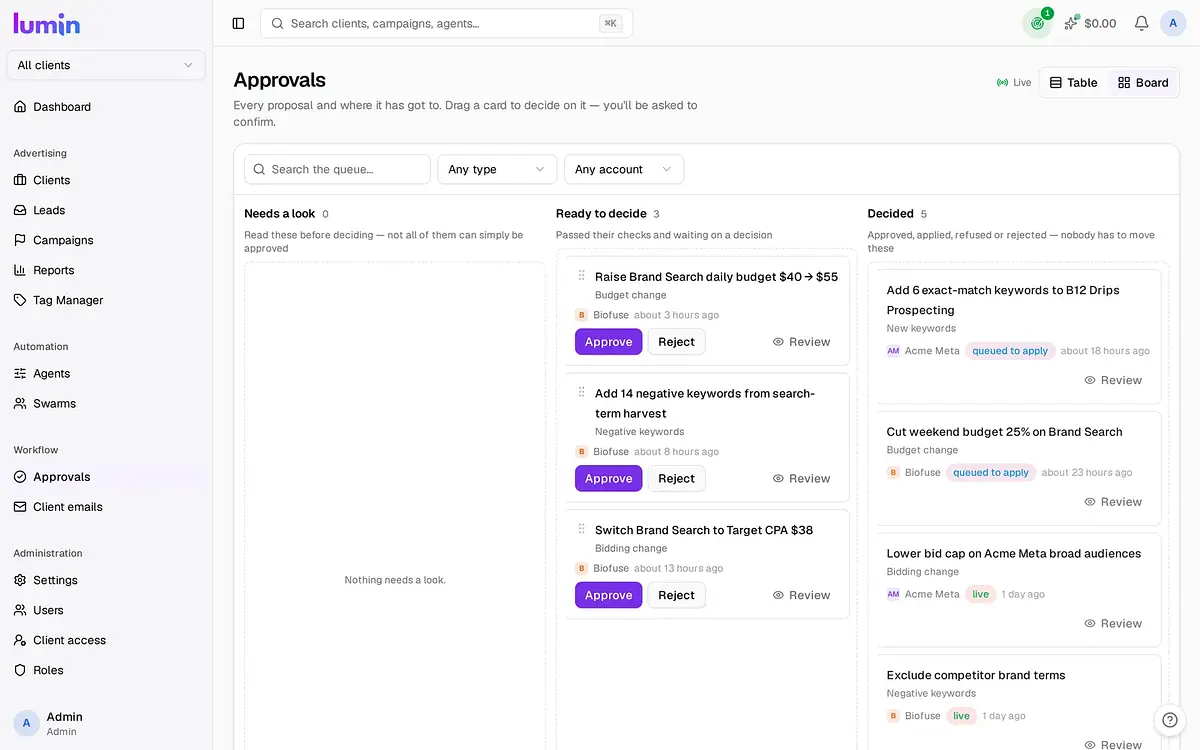
Google learns from the leads you'd actually call back.
Left alone, Google optimises for whatever it's told is a conversion, which is usually a form fill, and form fills include the tire-kickers, the job seekers and the wrong city. We close the loop: when a lead is marked sold or lost, that verdict goes back to Google as an offline conversion, and the bidding moves toward the searches that produce customers.
- Calls and forms tracked per campaign and keyword, verified before they're reported
- Sold-or-lost sent back from your CRM, your booking tool, or our app
- Reported as customers and cost per customer, not clicks and impressions
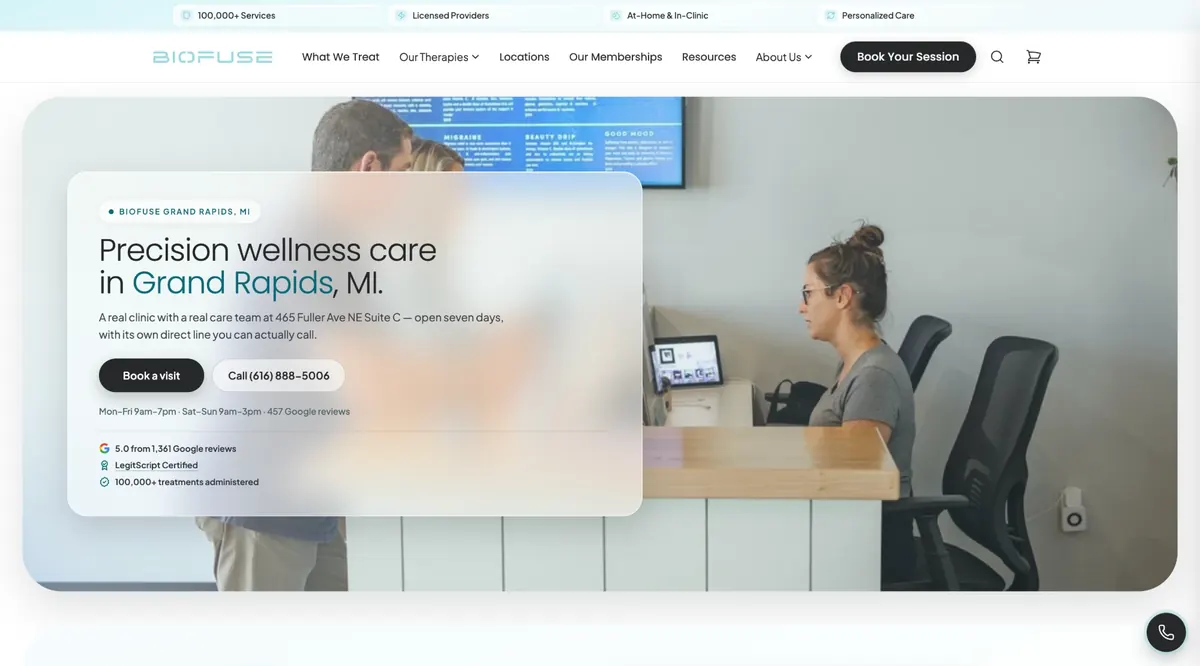
What you get, next to what you probably have.
| Most agencies | GoLumin | |
|---|---|---|
| Who owns the ad account | Often the agency's own account, so the history leaves when you do | Yours. In your name, revocable, and the history stays with you |
| Search terms reviewed | Page one of the report, when someone remembers | Every term, every day, with the spend figure attached |
| Where the clicks land | Your homepage, or a page you paid someone else to build | A landing page we build for the campaign and keep improving |
| What counts as a conversion | Whatever the dashboard was set to, often page views | Verified before it's reported. A page view is not a lead |
| Who approves a change | Unclear, and rarely recorded | A named person, never their own proposal, with the evidence attached |
| Spend limits | A reminder in someone's calendar | Hard limits in software. An over-limit change can't be applied, even after approval |
| Reporting | A monthly PDF | The raw platform data, and a plain-English email each week |
| Contract | Six or twelve months | Month to month |
Numbers from the accounts themselves.

More conversions
Years of SEO never became a lead source. A $30-a-day Google Ads test measured the market; the budget went to $100 once the calls lined up, and stopped there because the sales team was full, with 80% of the market still untouched.
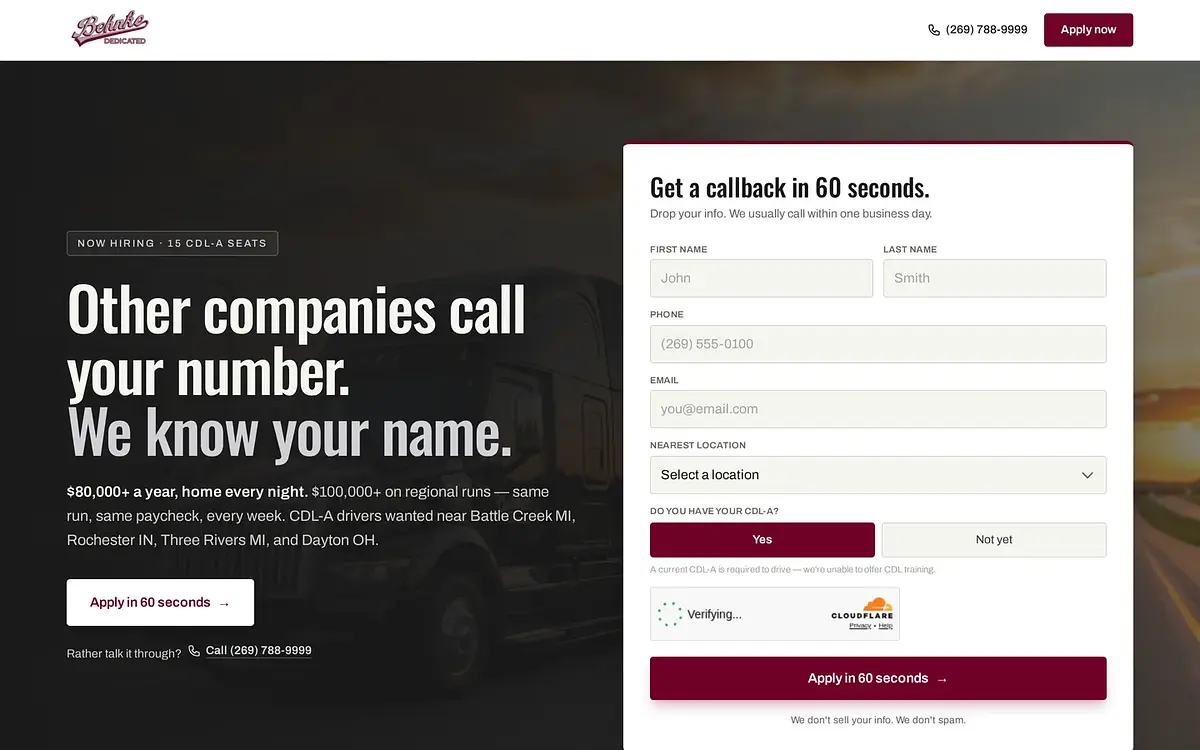
To fill every driver seat
One hiring page and Google Ads aimed at licensed CDL-A drivers in four markets. A month in, the campaign was paused because there was no one left to hire.
Cost per booked appointment
Twelve overlapping campaigns rebuilt into eight with one job each, negatives fenced in, tracking on the booking flow, four markets reported apart.
Of the original ads budget
Ads bought the first bookings from zero. As search took over, the ads budget came down to a third while the containers stayed booked.
Asked on almost every first call about Google Ads.
Do I need to be running Google Ads already?
No. If you're not, we look at what people actually search for in your market, what those clicks cost, and whether ads are even the right first move. Sometimes the answer is that your site or your local listings need the work first, and we'll say so.
What's in the audit, exactly?
The search terms that spent and never converted, with the dollars next to each one. The negatives that stop it, already written. Whatever is broken in your conversion tracking. Budget pacing. Ad copy that has run unchanged for months. Then a short ranked list of what we'd change first, whoever ends up making the changes. We go through it with you live, and you keep all of it.
How long before we see anything?
Audit findings come back within a few days of read-only access. Once an account is live, the first weeks are spent building enough conversion history for bidding to have something to learn from, and we'll tell you plainly where that stands rather than declare victory early.
Will you contact our current agency?
No. Read-only access is something you grant and revoke yourself in Google Ads, and it doesn't notify them. If the audit says they're doing fine, we'll say so, in writing.
Who owns the ad account?
You do. It stays in your name, and you can revoke our access any time without losing the history. We don't run clients out of our own account.
How is it priced?
A monthly fee based on ad spend, quoted after the audit once we know what's actually there. Month to month, no contract.
Start with an audit of what you already have.
A partner reads what you send and builds the audit against your real accounts, not a template. If you'd rather talk it through first, the number below reaches us directly.
Call us direct(415) 283-6736