
Google, Meta, Microsoft and ChatGPT. One crew. One approvals queue.
Your ad accounts stay in your name. Agents work them around the clock — cutting waste, pacing budget, rewriting tired copy — and every change they want to make waits in a queue for a named person at GoLumin.
- Google, Microsoft, Meta and ChatGPT
- Wasted spend found and cut continuously
- Budget paced, hard caps enforced in code
- Sold leads fed back to the ad platforms
Said on the first call, nearly every time.
- 01
“We're paying for searches that will never buy.”
Search terms are mined continuously and negatives proposed with the spend figure attached.
- 02
“Budget runs out on the 20th.”
Pacing is monitored against the month, and caps are hard limits rather than reminders.
- 03
“Our cost per lead looks fine and the leads are junk.”
Mark a lead sold or lost. That verdict goes back to Google and Meta, so bidding optimises for customers.
- 04
“Nobody can tell us what changed or why.”
Every change carries its evidence, its approver and its timestamp, and the record stays.
Every paid channel run as one governed portfolio, optimised toward qualified leads.
- 01
Read
Read-only access first. Agents inspect the live accounts and write up what they find, hired or not.
- 02
Propose
Each proposed change comes with what, why and the evidence — including the money at stake.
- 03
Approve
A named person at GoLumin approves or rejects. Never their own work. Software enforces the limits regardless.
- 04
Feed back
Calls and forms land in your inbox. Sold or lost goes back to the platforms as an offline conversion.
The software behind it, not the software you buy.
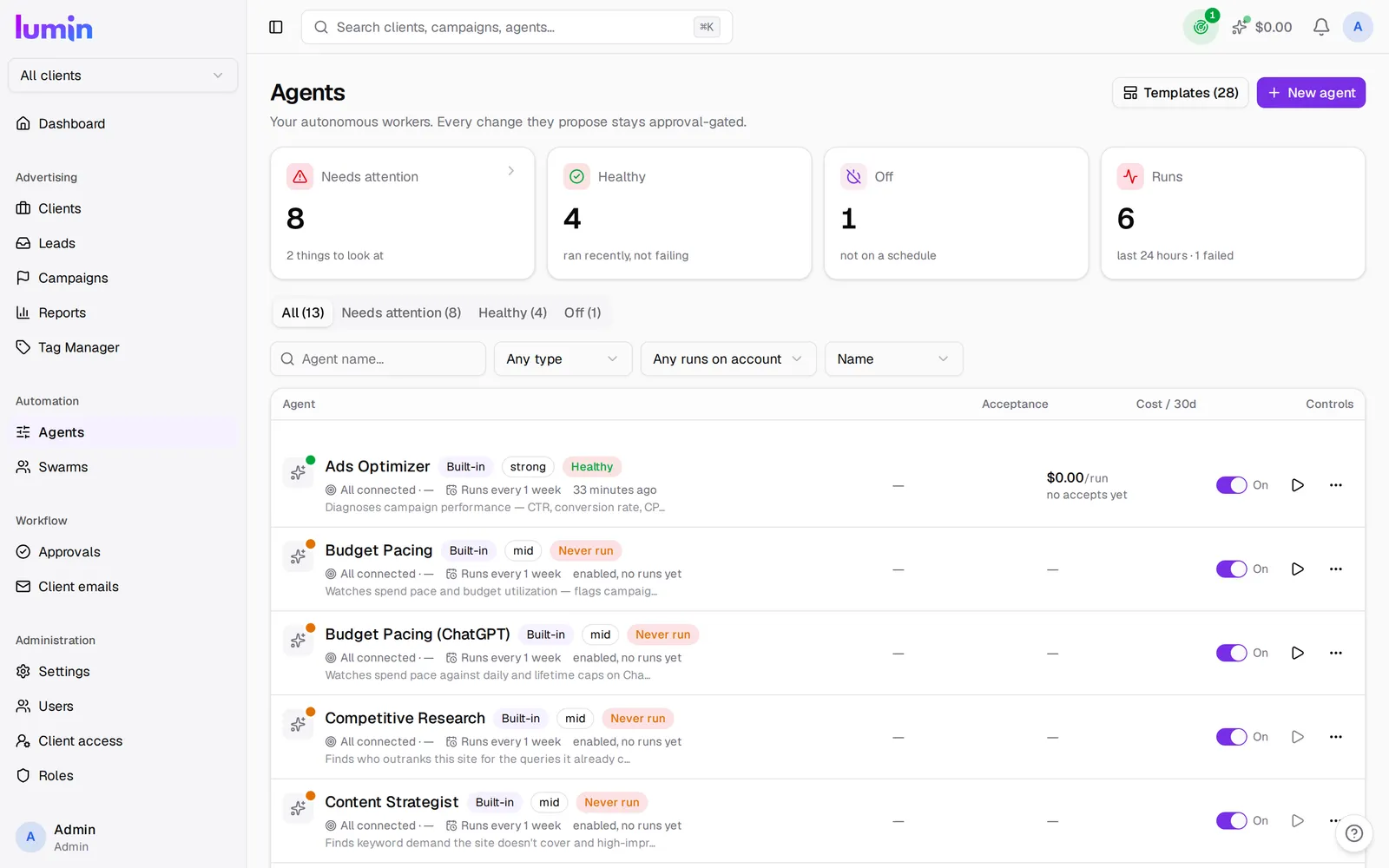
Every channel in one place, with a staff list of agents that each have a job, a shift and a manager, and a single approvals queue that everything passes through.
Agents inspect and propose. A named GoLumin operator approves. The software enforces the spend caps whatever the approver says. You can pause every agent on your account with one switch.
Where this is running today.
Every figure below comes from the live site or its sitemap at capture time. Where a client's performance data is theirs to release, we ask first and publish the baseline and the method with it.


Advertising hands off to Websites.
The lead outcomes advertising collects are what tells the website which pages are working.
Questions about advertising.
Who owns the ad accounts?
You do. Google, Microsoft, Meta and ChatGPT accounts stay in your name, and you can revoke our access at any time without losing history.
Can the AI change my ads on its own?
No. Every change waits for a named person at GoLumin. Spend caps are hard limits in software and cannot be overridden, even by an approver.
Who can change my spend?
Only an approved change inside the cap you set. A proposal that exceeds the per-change cap is blocked at the apply gate and shown to you as blocked.
What does 'ads in ChatGPT' mean?
It is a new placement alongside Google, Microsoft and Meta. We treat it as one channel in the portfolio, sized against the others, not as a headline.
What counts as success?
Qualified leads, and where you can tell us, sold ones. Cost per lead alone is easy to improve by buying worse leads.
Audit my ad account.
Read-only access, then the agents go through the account: wasted spend, missing negatives, broken conversion tracking, pacing, and the changes we would propose first. You keep the findings either way.
- Read-only access — nothing changes
- No obligation, no slide deck
- This form is a lead in our own inbox, timer running on us