
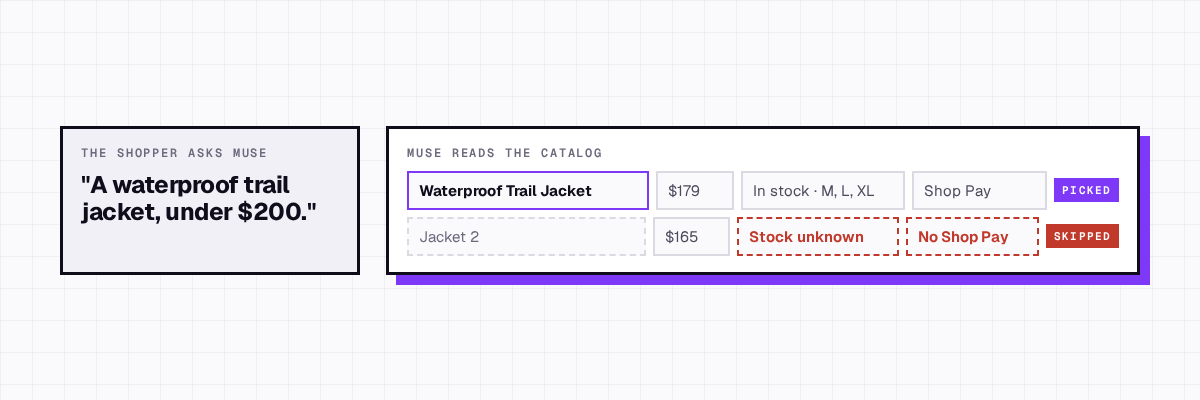
Shopify and Meta are partnering to let Meta’s personal AI agent, Muse, browse Shopify-powered stores and complete purchases, built on Shop Pay. Shopify CEO Tobias Lütke called it an “easy and delightful way to shop and check out with Muse.” Meta CEO Mark Zuckerberg put the pitch even shorter: “Shoppers find more. Shops sell more.”
The detail that matters for a store owner is the one Deutsche Bank flagged via the Wall Street Journal: AI platforms keep choosing to work inside Shopify’s infrastructure — Shopify Catalog organising the product data, Shop Pay handling payment and delivery, Shopify handling the back-end of the order. The agent is new. What it reads before it buys is everything you already own.
This is not another ad placement
Our last post was about ChatGPT Ads arriving one click away in Shopify: same feed, new placement, and three API properties that broke the Google playbook. This is the step after that one. There, the AI showed the ad. Here, the AI is the shopper — it browses, compares, and checks out on the customer’s behalf.
Muse launched earlier this month as a personal agent for everyday tasks, on iOS, Android, the web and WhatsApp, with tiers from free to $20 and $100 a month. Meta’s chief AI officer Alexandr Wang says the Shopify integration exists to give Muse users “a wide range of stores to find the absolute perfect products.” Translation: when a customer asks Muse to find something, Muse picks from stores it can understand and check out from without friction.
The merchant landscape just split in two
Amazon moved to block Muse from buying on its site, warning that an unauthorised agent violates its conditions of use. Shopify did the opposite: a cooperative path, with merchant consent built in through Shop Pay’s existing infrastructure.
That split is the whole story for independent stores. The biggest marketplace opted out. The platform most of you run on opted in, with the checkout your customers already trust. Shopify closed up 7.3% on the news, Meta up 11.4% — the market thinks this lane stays open.
What Muse reads before it buys
Nobody outside Meta and Shopify has the ranking formula. But the inputs are named in the announcement itself, and every one is something a store can fix this week:
- Your catalog. Deutsche Bank’s read is blunt: what Shopify does well here is organising product data through Shopify Catalog. Titles, descriptions, images, variants, prices, availability — that is what Muse compares when it looks for the “absolute perfect product.” Thin titles and stale availability don’t get clicked less. They get skipped entirely.
- Your checkout. The integration runs on Shop Pay, which holds the customer’s payment and delivery details. If your store checks out cleanly through Shop Pay today, you are already in the lane. If checkout needs a human to coax it — broken shipping rules, mystery fees at the last step, a payment method that fails on mobile — an agent bounces the same way a person does, only faster and without telling you.
- Your signal back. Muse users buy conversationally, which means your reporting has to tie the sale to the session that caused it. Sold outcomes fed back to the ad platforms is already how our clients teach Google and Meta what a customer looks like. Conversational buying makes that feedback loop more important, not less.
- Your Meta presence. Muse lives inside Meta’s apps. Stores Meta already understands — active catalog, honest creative, conversion history — start from a file that exists rather than a cold introduction.
None of this is exotic. It is the unglamorous product-data and checkout work that separates stores that get picked by an agent from stores the agent quietly passes over.
What Lumin stewards
This is the work we already do for ecommerce clients, pointed at a new buyer who happens to be software:
- Feed and catalog discipline. We keep the product data an agent reads accurate and complete — titles that describe the thing, images that show it, prices and availability that match the checkout. The same feed discipline our ChatGPT Ads work depends on.
- One portfolio, Meta included. We run Google, Meta, Microsoft and ChatGPT as one governed portfolio, not four logins. Meta is already in the queue we watch every day, so Muse shopping arrives as a new lane on a road we drive, not a new country.
- Agents that look, humans that sign. Our agents work the accounts around the clock — cutting waste, pacing budget, flagging stale creative — and every consequential change waits for a named person to approve. Spend caps are enforced in software at the moment of applying, and no approver can override them.
- Sold, not just spent. Calls and forms land in your inbox, and marking a lead sold or lost goes back to the platforms as an offline conversion. When Muse starts originating orders, that verdict is what teaches bidding the difference between traffic and customers.
What we don’t do
We do not have a Shopify app, and the distinction matters — same as with ChatGPT Ads.
Your catalog reaches Muse through Shopify Catalog and Shop Pay. That part is yours and Shopify’s, and it is better than anything we would build to duplicate it. What we steward is everything around it: the data the agent reads, the campaigns that put you in front of the customer before they ask an agent, the conversion signal that teaches the platforms, and the approval gate in front of all of it.
So the honest recommendation is: keep your store on Shopify’s rails, switch on Shop Pay if you haven’t, clean the catalog, then decide separately whether you want someone watching the lane.
If you want us to look first
We will audit an existing store and ad account before you commit to anything. Read-only access, real findings — catalog gaps, checkout friction, broken conversion tracking, wasted spend — and you keep them whether or not you hire us. If you already sell on Shopify, the first thing we will tell you is what Muse would read about you today.
Most stores are surprised by the answer.