
Start with a thermostat
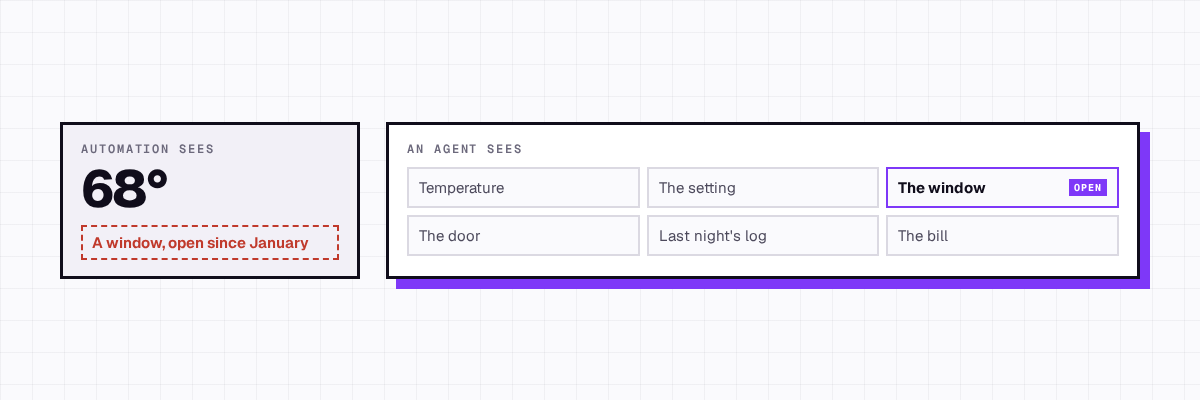
Your thermostat holds 68 degrees, and it is very good at this. Somebody leaves a window open in January and it will heat the street until March without ever mentioning it. It is not broken. “Check whether a window is open” was never in the rule.
A person on the night shift walks past the same window and tells you. They are not smarter than the thermostat about temperature. They were looking at something nobody told them to look at.
Automation · what it can see
- The current temperature
- The number you set
Heats the street until March. Never mentions it.
An agent · what it can see
Notices the window. Not because it is cleverer about temperature, because it was looking at something nobody told it to look at.
That gap is the whole idea, and it is worth one line:
Automation follows instructions. An agent forms an opinion.
Everything below is that sentence, unpacked.
Three kinds of software you have already met
You have used all three. Only the names are unfamiliar.
A tool does nothing until you pick it up. Your CRM, a spreadsheet, the photo editor nobody on staff knows how to use. Every action is yours. Stop touching it and nothing happens, which is why most software a business buys ends up unused.
Automation is a rule you wrote down once. When a form is submitted, email me. If spend passes $100, pause the campaign. Fast, reliable, and blind. It does exactly what you specified, forever, including long after the situation changed and the rule became wrong.
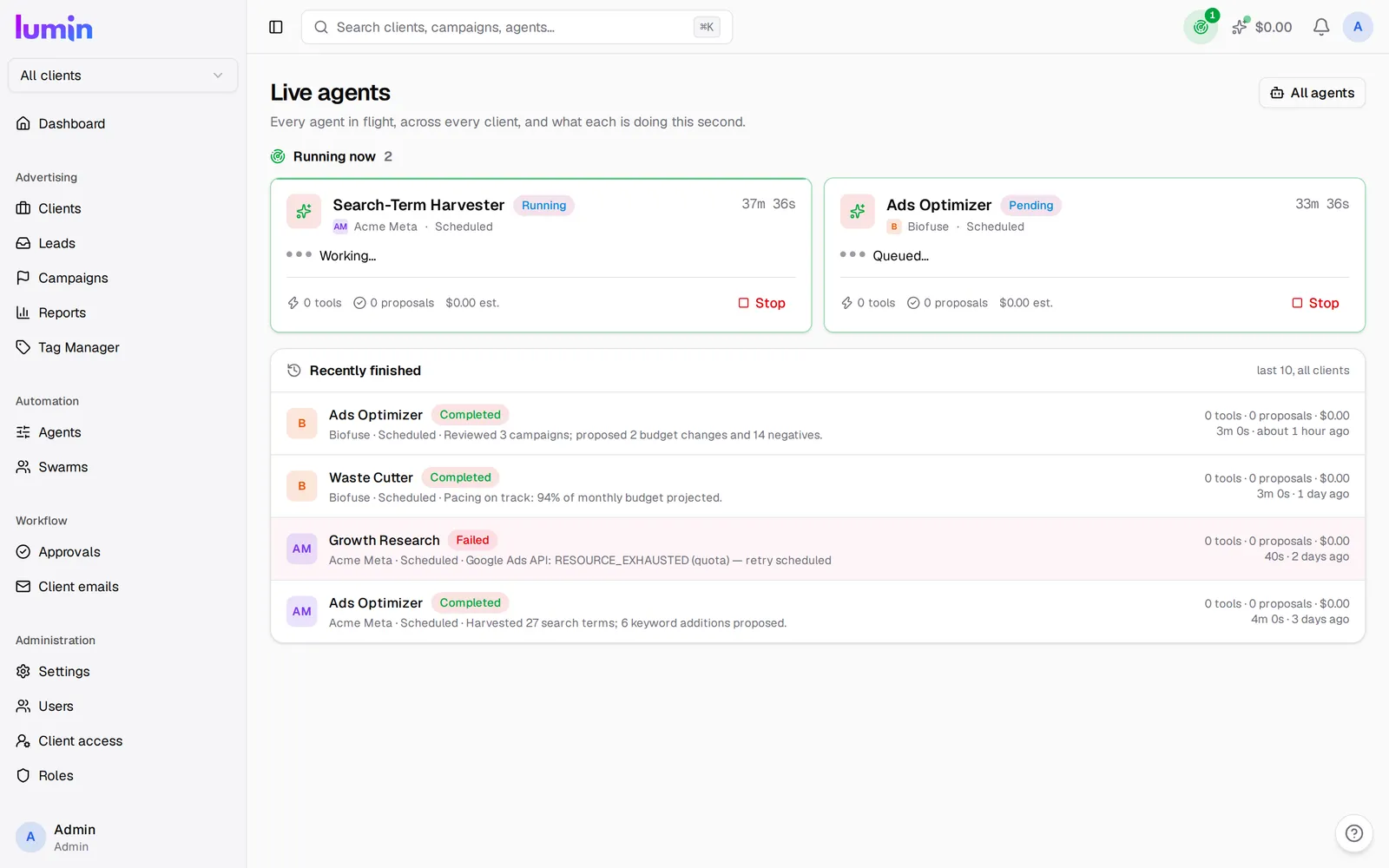
An agent has a job rather than a rule. You give it a goal, access to look at things, and a schedule. It goes and looks, works out what is wrong, and writes up what it thinks should be done about it.
Does nothing until you pick it up. Stop touching it and nothing happens.
Fast, reliable and blind. It cannot notice what you did not anticipate.
Goes and looks, works out what is wrong, and writes up what it wants to do.
What one does on a Tuesday
An agent on a website has one standing job. Say: find pages that have gone stale, thin or broken. It runs on a schedule, the way a shift works.
Tuesday morning it reads the site the way a search engine does. It finds a service page untouched in fourteen months, still listing a price you stopped charging in March. It finds a contact form that has been silently failing since a plugin update. It finds that no page answers a question your customers ask constantly.
Then it writes that up: what it found, what it wants to change, the evidence, and what it is worth.
And then it stops. Because the interesting part of an agent is not what it can do. It is what it is not allowed to do.
The question you should actually be asking
Every owner arrives at the same worry, and it is the right one: so this thing is making decisions about my money while I sleep?
The answer depends entirely on the agency. Pin it down before you sign anything.
Ours have read access and no ability to apply anything. They inspect, research, draft and propose. They cannot publish a page, change an ad, or move a dollar. Every consequential change is written up and handed to a named person who signs or rejects it, never their own work, and their name stays on the record next to the change.
Underneath that, spend caps are enforced in code at the moment of applying. A change that would exceed the cap cannot apply even when a human has already approved it. The approver cannot override it either. That is the difference between a limit and a promise.
You also get one switch that pauses every agent on your account, instantly.
The useful way to picture an agent is not a robot. It is a new hire in their first month: quick, tireless, reads absolutely everything, and not allowed to sign anything.
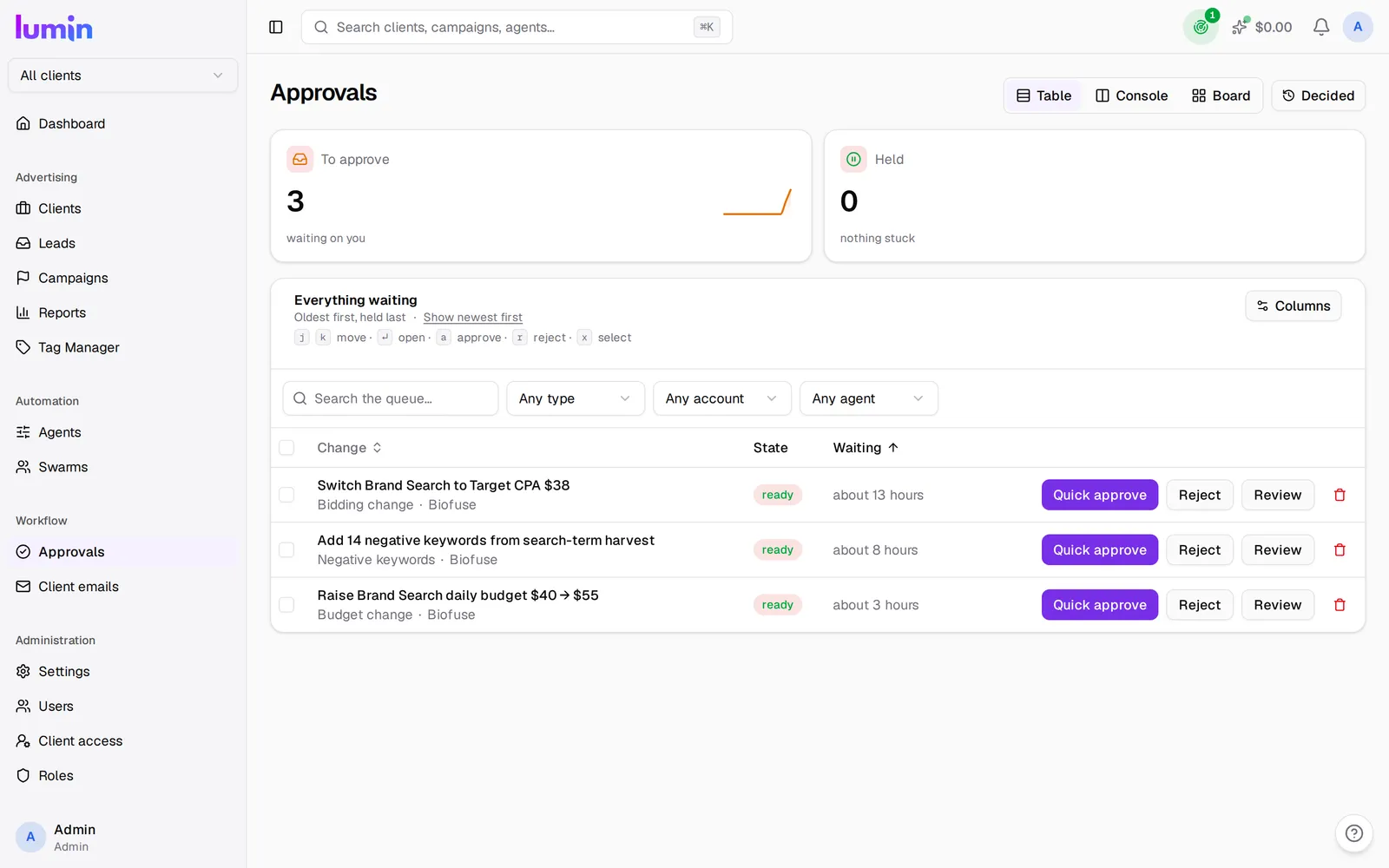
If an agency cannot tell you clearly what their AI can change without a person, that is not a detail they are glossing over. It is the whole product.
Why 2026 and not 2015
The argument is not that the software got clever. It is arithmetic.
Marketing used to fit in one head. A twelve-page website. A Google listing. One ad account. A competent person could look at all of it in a week.
Today we run sites with 632 pages, one for every town and zip code a client delivers to. We migrated a law firm with 324 URLs. A clinic publishes 75 treatment pages, each with its own price. On top of that: a business profile wanting posts, photos, hours and answers. Details that must agree across Google, Bing, Apple Maps, Yelp and dozens of directories. Ad accounts on Google, Meta, Microsoft, and now ChatGPT.
The number of things that can quietly be wrong went up a hundredfold. The number of hours in a retainer did not.
One person could look at all of it in an afternoon.
Plus a business profile, forty directory listings and four ad platforms.
Try this honestly. Take what you pay your agency each month. Divide it by an hourly rate you would consider fair for a competent marketer. That is roughly how many hours your entire marketing gets looked at, by anybody, in a month.
Now ask that many hours to check 632 pages, forty directory listings and four ad platforms. It cannot be done, and it never has been. Not because agencies are lazy. The arithmetic does not work.
So an agency without agents samples. It does the handful of things it can reach, and everything else goes unlooked-at until somebody complains.
You have already lived the consequence
You found it yourself. The contact form broken for six weeks, which you discovered because a customer mentioned they had tried to reach you. The Google listing saying you were closed on Saturdays for most of a year. The ad group that spent $1,400 on a search term that was never going to buy. The page still advertising last spring’s offer.
Not one of those was difficult. Every one is obvious the moment somebody looks. They were not failures of skill or strategy.
They were failures of attention. Nobody was looking at that thing on that day.
Attention is what agents supply. Not cleverer than your marketer. Never not looking. Eight of them, one job each, on a standing rota: technical sweep daily, metadata and internal links weekly, content gaps and structured data monthly.
AI answers punish inconsistency
There is a reason this got urgent this year.
When somebody googled you they got ten links and used their own judgment. If your Yelp hours disagreed with your website, it was untidy and a human worked it out.
When somebody asks ChatGPT for a plumber, a lawyer, a storage unit, they get one answer with a couple of businesses named. That answer is assembled from what the internet consistently agrees about you. No second page, and no judgment applied on your behalf.
Disagreement used to be untidy. Now it is a reason to be left out.
Keeping dozens of surfaces in agreement forever, checking for the one directory with your old suite number, is high-volume, low-judgment, never-finished work. Exactly what humans are worst at and most expensive for.
What agents are bad at
An agent does not know what your business wants this quarter. It does not know you are moving away from the low-margin work, or that the new location matters more than the established one. It has no taste. It cannot tell you which leads were worth having, and only you know that. It cannot hold a relationship, negotiate, or decide strategy.
It should not be trusted with consequences either. That is not a limitation we apologise for. It is why the approval gate exists.
So the claim is narrower than “agents replace your marketer”. Agents do the looking, so the expensive human does the deciding. An agency without agents is spending senior hours checking whether a page has gone stale. You are paying strategist rates for proofreading.
The dead end, precisely
“Dead end” is a strong phrase, so here is the exact claim.
It does not mean an agency without agents fails tomorrow. Plenty are excellent and will be around for years.
It means the only way to keep the cost sane is to look at less of your marketing. That was a reasonable trade in 2015, when there was less to look at. It gets worse every year as the surface area grows and the retainer does not. The road keeps going. It stops going anywhere you want to be.
Four questions to ask any agency this year
You do not need to understand the technology to test whether someone is using it honestly. Listen for specifics rather than enthusiasm.
- “Who looked at my account this week, and what did they look at?” A good answer names the things checked. A bad one describes a process.
- “What can your AI change without a human signing for it?” The right answer is nothing consequential. Hesitation here is the answer.
- “Show me the last thing your AI proposed that you rejected.” If nothing has ever been rejected, either nothing is being proposed or nobody is reading it.
- “What is the spend cap, and who can override it?” The right answer is that it is enforced in software and nobody can, including them.
We wrote our own CMS and ads platform so we could answer all four, and the answers are published at how it works and trust rather than saved for sales calls.
If you would rather see it
We will audit what you already have. Read-only access, real findings written down, and you keep them whether or not you hire us. It is also the fastest way to see the difference this post describes, because the audit is the thing an agent does, run once, in front of you.
Most of what we find is not clever. Nobody had looked.